For nearly 40 years, Judy Garland was the icon of the Hollywood life and classed as one of the greatest entertainers of her generation. She was performing on stage and in movies from a very young age and at 16 she brought The Wizard Of Oz to life on the big screen. She followed this with many movies and a staggering amount of concert appearances that broke box office records.
Behind the scenes it was a different story. From an early age, MGM Studios had been plying its young actors with ampthetamines and barbiturates to keep them going through the back to back filming schedules required to keep new movies being released. This went hand in hand with the glitzy lifestyle and constant rotation of work/party/premiere/work that made up the backbone of Hollywood.
Despite a hectic work schedule and much critical acclaim, Judy Garland's personnel life was a shambles. By the early sixties, five marriages and a life long battle with alcohol and drug abuse had taken its toll on her. In a bid to get her back into the public's eye it was decided she would write an autobiography. Enter her agent, Irving "Swifty" Lazar. He supplied the ailing star with a reel to reel tape recorder and got her to use it as a way to get the book started as well as maybe come to terms with her problems.
What follows has become known as the "Judy Speaks" tapes. Still mainlining pills and a ludicrous amount of gin, she sobs and screams at ex-husbands, film executives, her complete distrust of the recording device and pretty much everyone who she believes led her to this point in life.
Bear in mind that its pretty heavy going at times. Her booze soaked rendition of Somewhere Over The Rainbow is pretty heavy. As legend goes, these tapes got confiscated after her death in 1969 and ended up locked away in a publicist's vault before getting a public release some years ago. Judy's family actually petitioned for them to be denied a release but the court ruled otherwise.
Its pretty heavy going stuff at times. Some brief moments of cohesion and happiness are soon washed away by Judy's gin soaked anger and vitriol. Be warned.
IllCon Radio returns tonight with a whooper of a program. Author Martin F. Dinner will be on to discuss his new self-published book The Morrissey Conspiracy! A hard hitting expose on the former Smiths singer's involvement in the murder of Princess Diana, The Illuminati and international mind control among other things. Pretty sure Moz is a racist too. After that it's open lines so give us a ringy ding ding at 415-829-2980.
Illogical Contraption Radio tonight LIVE in Studio 1A 10pm-Midnight PST on FccFreeRadio.com
Ladies and Gentlemen, allow me to introduce supreme bro and inspired individual, BEN VENOM.
(Evil Muahahhahahaha)
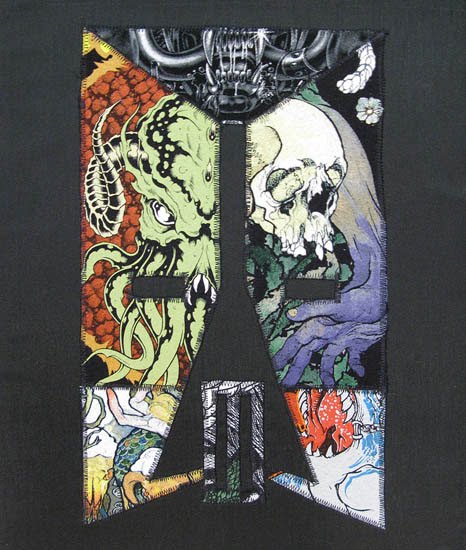
You know all those shirts you've been hoarding since you were in your tweens? They've got holes in them huh? Holes that expose your nipples, holes that your bullet belt gets stuck on, holes that you keep your drumsticks in, holes holes holes. Well, Ben has been collecting these shirts for almost two decades. What he did with his ding dang ol' shirts turned into works of brutality that I'd probably saw my left leg off for.
(Truly, a masterpiece)
I caught up with Ben the other night over a few bro-brews to get a glimpse into what inspires him to give up those precious precious shirts. (Dude, it would take hell or high water for me to give up original shirts like TESTAMENT and METALLICA and MAIDEN. Geez) He's got big things on the horizon and needs our help (I'll explain later).
Satan's Little Helper's Station
Ben-vacuuming on the Lord's day at a church in a Slayer shirt. He probably threw up in a trash can at said church too, huh Ben?
He says that creating these quilts is like creating a song...creating drafts, putting the pieces together as you gain inspiration, using recycled material...er...that last part shouldn't be for song writing, although sometimes it's cool if your ripping of Black Sabbath for the umpteenth time.
Ben's got some big shows coming up on the horizon people- first off a Metal-Themed art show in Birmingham, England; (where the greatest of English Heavy Metal hail from) THEN a huge show at the Yerba Buena Museum here in San Francisco. Why is this of importance to you, you ask? Well, Ben needs our help. I know a LOT of you are in shitty metal bands out there, and he needs your shirts, patches, chonies, WHATEVER to make a GIANT metal quilt of the most Satanic breed. Send him your shirts that are stretching over your ever expanding beer belly. Send him your lame band shirt, so that your band will live on in infamy. Send him that Manowar patch that's holding the crotch of your favorite pair of Jorts together. Support him, so that he may go forth in Evil.
I want to see this at every Museum from now til forever
And I want one of these pillows. Don't you?
"When Hell freezes over, you can use my quilt to keep warm" -Ben Venom
In the history of popular music, very few origins are certain. There are hundreds of arguments, and discussions to be had about who did what first, who did what best, who did what without selling out, blah blah, and the debates go on and on in bars, basements, coffee shops, record stores, chat rooms, and blogs, throughout the world and the world wide web unabated and undecided, and likely will forever. As an art form, popular music is routinely neglected by "serious" historians as, at worst, unimportant, and at best, less important than "high minded" classical or jazz music. And even among researchers of popular music a hierarchy exists regarding what is true research and what is just journalism. Folk music gets serious cred, as does Bob Dylan, The Beatles, The Beach Boys, and Sun Records. You can get a PHD writing about these things at respected universities - the symbolism of Bob Dylan's poetry; the socio-economic significance of rock and roll on the South in the 1950s; the introduction of the blues into popular music; the impact of The Beatles on western culture... these are the topics which sequester the attention of the intelligentsia of popular music and as a result, it will be a long time before other important questions receive receive serious attention. So, for better or worse, it is up to people like us to decide these things for ourselves. Who were the first punks - The Sex Pistols, Richard Hell, or The Ramones? The first metal band - Sabbath? Cream? Blue Cheer? Who invented rap music - Kurtis Blow? Kool Herc? Who invented sampling?
Now, wait, there's a question with an answer. But it may not be one you'd expect. According to Wikipedia, sampling is "the act of taking a portion, or sample, of one sound recording and reusing it as an instrument or different sound recording of a song". While that may be a horribly insufficient definition of the term, it works well as a description of sampling as a simple technique. Though it has a long and turbulent history, marred by numerous lawsuits and vehement controversy, these days sampling has come to be regarded as not only a respected art form, but an ubiquitous one as well. Snippets from songs, movies, and commercials, hell even political speeches are commonly harvested from old 45's and LP's to enhance the work of artists from Jay Z to Suffocation, and, sampling has held as one of the most profitable tentacles of the music industry, despite the general confusion about the future of said industry. But in the beginning, it was all a joke.
Though he may not look like it, Dickie Goodman (left) was one of the most important individuals in the history of popular music. Not only is he the man who, for all intents and purposes, invented the art of sampling, he is, more importantly, the person most responsible for it's popularization and legitimization.
Dickie was born in Hewlett, NY in 1934 to the family of a General Electric attorney who had a taste for musical parody.
"My grandfather was an attorney," says Jon Goodman, Dickie's son and author of The King of Novelty, a memoir about his father's life.
"Somehow he knew the president and he did a song parody of 'Casey at the Bat' called 'Franklin at the Bat'. The song was a tribute to Franklin Delano Roosevelt and my grandfather presented the record to FDR and FDR autographed a copy for my grandfather. Maybe that's where it all began."
According to this very trustworthy and well written article Dickie attended NYU in the 1950s before teaming up with another struggling songwriter, Bill Buchanan, to write pop songs. In between cold calling record executives from pay phones to solicit meetings, Buchanan and Goodman came up with the idea to produce a parody of Orson Welles' infamous The War of the Worlds radio hoax (above), which purported to be an authentic newscast of an alien invasion of Earth. But instead of a seemingly real newscast, Goodman and Buchanan developed the idea of splicing snippets of popular music into the story as responses to the query's of a fictitious reporter. The result was "The Flying Saucer", which used samples from artists such as The Platters, Elvis Presley, Little Richard, Fats Domino, and Chuck Berry. The record was self-produced and primitive. In many ways the record was juvenile and highly suspect from an artistic point of view. But it was also ingenious and incredibly hilarious, and most of all, wildly popular. Within a few weeks of it's production the pop music phenomenon of the 'break in record' was born and the eventual 'King of Novelty' had begun his strange journey.
"He was very funny," says Jon Goodman. "He had to make a joke out of everything. When he did "Mr Jaws" the record company executive asked who to make the check out to and Dad said 'Cash'. The record executive said he would need a corporation named CASH in order to do that. So my father incorporated a record label called CASH just so he could have a check made out to 'Cash'. That's either funny or insane."
"Mr Jaws", a parody of the hit film Jaws in which a reporter interviews the shark about his exploits, would go on to earn Mr Goodman a number one record on the Top 40 charts, and the title of "#1 Novelty Record of the Year" by Billboard, as well as three gold records.
But the success Mr Goodman would later enjoy didn't come easily. Initially ignored, "The Flying Saucer" was released on Luniverse, a label created by the Goodman, but was quickly picked up and distributed by larger agents. Despite it's popularity, it was banned by several radio programmers that hadn't forgotten the confusion caused by the debacle surrounding the original broadcast of The War of the Worlds. And, as the popularity of “The Flying Saucer" grew, others began to produce copycat recordings in search of a quick buck. Eventually, Goodman and Buchanan began to draw the attention of publishing houses and record labels - and they weren't looking to wine and dine the duo, or sign them to lucrative multi-record deals. Instead, they were looking to sue them for their efforts, claiming copyright infringement, even though they had been collecting royalties on the recordings from a previous settlement. The trial took place in November, 1956 and concluded shortly thereafter with the judge concluding that Buchanan and Goodman's recordings were "interesting novelty records" and claiming that he couldn't "determine whether or not the defendants have exceeded the bounds of fair competition". In short, break in records were considered parody and satire, and the judges decision essentially transformed the technique of sampling into fair game, if not a legitimate art form.
"The legal battles they fought were almost as important to musical evolution as the innovations themselves," says Dr Demento (right), world renowned scholar of popular music and host of the ultra-awesome, long running syndicated radio program The Dr Demento Show.
Buchanan and Goodman responded to their legal troubles by producing a second break in record, "Buchanan and Goodman on Trial" as well as a parody of their own parody with a piece entitled "The Flying Saucer Goes West".
"In those days you didn't have many choices," says Jon Goodman. "You had three television channels and the main newscasters on those channels were the guys everyone on earth was watching. Same with radio. Dad walked right into the biggest radio station on earth and asked them to listen to his recording. Even if you could do that today, walk right in and have someone actually listen to you, which one would you walk into out of the millions of media outlets now available?"
Buchanan and Goodman would part ways in 1957, but both continued to pursue careers in the music business, creating break in records and writing pop songs throughout the golden days of rock and roll, into disco, and beyond. Though he is not the focus of this story, Bill Buchanan was as important as Mr Goodman to the development of sampling and is due a great deal of respect. Though his discography does not approach the epic proportions of Mr Goodman, he did work with The Three Stooges, which is hella awesome in my book.
While the duo lasted, "The Flying Saucer" remained a lucrative theme and they produced several martian themed break in's.
(Aside)
In regard to the newscast format:
"'The Flying Saucer' imitation of John Cameron Cameron was a parody of then famous newscaster John Cameron Swayze," says Jon Goodman.
John Cameron Swayze was a pretty cool dude (and I'm only throwing this in because, much like myself, Mr Swayze is a Kansas native). He was born in Wichita, KS (a terrible little city, if you ask me, that has produced little of mention outside of Mr Swayze and the BTK Strangler, as well as several skinhead jerks with a penchant for sucker-punching Crass fans in the face, and one near saint, Mr Chris Stong, a personal idol of mine, but most importantly the Nu-Way sandwich shop, home of the most delectable loose-meat sandwiches on earth - if you ever travel through Kansas be sure to stop at Nu-Way - trust me, you will not forget it). In addition to being a prominent news personality in the 1950s, Mr Swayze is most fondly remembered as the face of Timex watches and their "It takes a licking and keeps on ticking" advertisements. Oh, and he was also a sixth cousin of Patrick Swayze, the patron saint of this blog.
(Back to normal)
But the duo's influence was greater than simply allowing artists to appropriate the work of others to enhance their own recordings. By using original recordings in their samples, Buchanan and Goodman helped to spur interest in artists who had been intentionally ignored by the radio because of the color of their skin or the type of music they played.
"His influence on pop culture is far more dramatic than people know," says Jon Goodman. "Just the mere fact that his first record used the original artists rather than socially acceptable cover versions was huge. Stations that would not play 'race' music in the fifties were forced to play Elvis and Little Richard rather than the Pat Boone versions [of popular songs] because listeners called in to request those songs after hearing them on 'The Flying Saucer'."
"That trend was already gathering momentum before 'The Flying Saucer'," says Dr Demento. "But by freely mixing R&B records with those by white artists, Buchanan and Goodman did their part to bring R&B into the mainstream."
Goodman also regularly used his work to satirize current events and the world around him. In "Energy Crisis '74" he lampooned Richard Nixon and Gerald Ford and other world leaders for the ineptness, greed, and outright stupidity that caused the fuel shortage of of the mid-1970s. In "Berlin Top 10" and "Russian Bandstand" (the latter recorded with Mickey Shorr under the name Spencer and Spencer) Goodman poked fun at the oppressive tactics of the Soviet Union. In "Election 1980" Goodman satirized both Jimmy Carter and Ronald Reagan.
Whimsical Will (right), an acolyte of Goodman's work who has produced his own ingenious brand of break-in recordings since the early 1980s forThe Dr Demento Show, suggests that Goodman's work also serves another important function: historical artifact.
"I like to think of Goodman's 'break-in' interviews as audio time capsules, in which he would mock query a popular movie character or personality of the day and use bits of current top 40 songs as answers. Listen back to say, 'Mr Jaws' and be treated to a quick summary of the big hits of 1974-75, with the blockbuster movie of the year as it's theme."
(As I've already posted "Mr Jaws", I've chosen to post Goodman's "Kong" instead as an example.)
When it comes down to it, all of the questions about Mr Goodman and his importance to popular music really aren't that, well, important. Though he received numerous awards and accommodations throughout his career, he is best remembered as an entertainer, the Neil Diamond of the novelty record, someone whose quirky brand of comedy never failed to produce a smile, at least, for the listener. Like an aural version of slapstick, Goodman's recordings are hilarious for both their unpredictability and absurdity. Think of a Marx Brothers movie or an old Charlie Chaplin short: while you might know the basic plot, you never really know what's coming next, and once it happens it seems both outright impossible and terribly appropriate. In Goodman's "Luna Trip", "Walter Funkite" (a parody of Walter Cronkite) interviews the astronauts of Apollo 11 about their trip to the moon. When he asks Col Michael Collins (aka, the one that stayed in the ship) how he occupied himself while Neil Armstrong and Buzz Aldrin descended to the moon, Collins replies with "Listening to that good old rock and roll!", a clip from an old Cat Mother and the All Night Newsboys song. Later "Funkite" asks the astronauts what they missed most about Earth and is met with a response from the Rolling Stones: "The Hawww-awww-nky Tonk Women!", all while being to "Shut Up!" by the Alvin and the Chipmunks-like voice of the "Moon Man" that witnessed the landing. The whole thing is a chaotic mish-mash of comedic stick and move that would be frustratingly confusing if it wasn't so damn funny.
Throughout his career, Goodman's work seemed to return to a few central themes. Popular movies were a constant reference point and, in addition to Jaws, Goodman also recorded parodies of ET and Star Wars, among others. But he also loved to poke fun at popular obsessions. Comic books characters like Batman, and monsters from now classic horror films were regular subjects of Goodman's wit.
"On a technical and performance level Goodman has influenced my style by demonstrating that less is more," says Whimsical Will. "Keep the song snippets brief and the questions rapid-fire. Don't reply to the song replies, a trap many break-in newbies fall into, and keep the edits smooth and tight."
Wolf Roxon, co-leader of fabled St Louis punk innovators The Moldy Dogs, also cites Goodman as a major influence,particularly during his formative years before forming his first band Wolfgang and the Noble Oval. As a teenager, Roxon cut his teeth making break in records of his own with co-conspirator Jon Ashline.
"By imitating [Dickie's] craft, Ashline and I became successful, in our own world and on a very small scale, doing something that was considered an art," Roxon recalls. "Of course, we discovered many songs by listening carefully to lines we could sample for our recordings. In other words we developed ears in finding samples, inflections of lines and words, and worked with recording equipment. I doubt Wolfgang and the Noble Oval would have happened without us first getting together and attempting to master Mr Goodman's skills."
"It certainly led us in the right direction as far as our love of music and it's fascinating power," adds Ashline.
Though he is remembered primarily for his break-in records, Goodman was a true man of the music industry, and he wore several hats in the course of his career. For instance, Goodman also recorded original music and hardcore music geeks worldwide will recognize his presence on some classic songs, some parodies, some wholly original compositions. The most memorable is "Frankenstein Meets the Beatles", recorded under the moniker Jekyll and Hyde, with Bill Ramal (who worked with Del "My Little Runaway" Shannon).
Goodman also worked as manager and producer. In the early 1970s Goodman, along with Ramal, recruited a group of aspiring musicians to form a group called The Glass Bottle. The band was nothing more than a promotional gimmick for the glass industry, which was facing competition from plastic and aluminum in the lucrative soda bottling industry, and the band didn't last very long. The very trustworthy and well written article I mentioned earlier tells the story better than I can, but here is a clip from the most memorable song The Glass Bottle produced.
Jon Goodman, who has worked hard to preserve the legacy of his father, even making his own break in records, has only one regret about his father's career." The biggest failure of the whole thing is never having brought his records into TV or movies,"he says. “He never made that happen and I have never been able to make that happen. I grind my teeth when I see programs on TV about UFOs and things in that genre, when they cover the modern day origins of how those things are related to pop culture and they fail to play a clip from 'The Flying Saucer'."
Dickie Goodman died in 1989. Since his death he has been honored with a posthumous Grammy award, and recognized by both Billboard and The Guiness Book of World Records as the most charted novelty artist of all time. His legacy can be seen throughout the music industry, and any artist that has ever sampled a line from a movie or a "beat" or chorus from a song owes him a serious debt of gratitude, and not just for his pioneering work with sampling or the legal battles he fought, but for his commitment to sampling as a viable artistic tool.
“Dickie and Bill pioneered the use of samples, fragments of previously existing recordings, in creating a new work," says Dr Demento. "This ultimately led to the extensive use of samples in hip-hop music, and today's popular "mash-ups. Despite constant litigation, Dickie was able to keep virtually all his work on the market with minimal alterations, something that would have been all but unthinkable before "Flying Saucer."
"[They], created a whole new genre of music that hadn't existed before,” he continues. “And Dickie enjoyed a long, if intermittent, success with it. That's quite an accomplishment right there."
I am sure you're all familiar with Patrick Swayze's character "Dalton" from the 1989 film Road House (right). Loved by women and feared by men, Dalton packs not only a punch but also a degree in philosophy from NYU -- a thinking man's warrior, of sorts. He is the Ultimate Bouncer, a deadly blend of strength, brains, agility, and mysticism. Mike Scalzi is basically the Dalton of heavy metal, right down to the degree in philosophy. Singer, lyricist, and guitarist for the mindbendingly shredderiffic (Lord Weird) Slough Feg (read a super lengthy IC post about them here), Scalzi has been successfully marrying folklore and metal for over 20 years now, and showing no signs of fatigue. Dude is a champ. So imagine my unbridled giddiness when homeboy agreed to an interview with IC. Sweet!
But this ain't your "average" interview. No less than four members of the IC Team contributed to this post, making it a virtual CROSSFIRE OF Q&A BRUTALITY. Watch as Scalzi strikes us down, one by one, into the raging fires of Hades. The horror!
(These first three questions come courtesy of Brother Seanford AKA Seanu Reeves, whose band, Professor, recently shared the stage with Slough Feg in L.A.)
1) When I saw you last Saturday in Los Angeles, I noticed that there were a considerable amount of hot girls in the audience. Was that an anomaly for a Slough Feg show? Did it make you nervous?
Was it strange to have girls in the audience? Not in San Francisco, we usually get a few girls around here. But in somewhere like Arizona of Chicago it would be weird, unfortunately. Why the hell would it make me nervous? I get nervous when there’s nothing but a bunch of overweight fan-boys in the audience with tattoos of my face on their calves, that makes me nervous!!!
2) I noticed Adrian (Maestas, Slough Feg bassist) was wearing a spandex leopard print shirt. Is this something you often fight about?
Left: The dudes in question.
This is a stupid question. Of course we don’t fight about it. Adrian dresses like a queer, that’s good. That’s what skinny little rockers are supposed to do. You see the shit I wear on stage, well, sometimes people try to ask me stupid questions about it, as if I actually take all of this seriously. Well, I do take it seriously, I’m serious about putting on a show and keeping people’s attention, my wearing gay looking clothes does just that-----if you haven’t noticed musicians have been doing that since before we were both born. Its called performing, wearing a flashy costume----not putting on baggy jeans and a Cannibal Corpse t-shirt with your hair in a pony tail and staring at the floor for the whole show because you mommy and daddy didn’t have the sense to make you watch Mr. Rogers and learn to look people in the eye with confidence when you address them----particularly when you’re performing on a stage for them. 99% of the bands you see these days have no business being put on a stage for a “performance”----they can’t perform their way out a paper bag. No wonder shows are so poorly attended and people seem so bored, because the bands are never holding up their end of the bargain and putting on a show. If I want to see a bunch of insecure phony punks scowl and roll their eyes and act like fourteen year olds I can go teach philosophy classes!!
3) You have a considerable cult following, however your fans are in need of branding ala the kiss army, dead heads, and juggalos. Do you prefer Sloughdiers or perhaps simply Trekkies?
This is a actually a decent question, and a decent proposal (want to be in charge of our fan-club!?!?). There was one guy on our message board who started addressing everyone as “Feggots”, which I thought was rather appropriate, seeing as there are maybe three Slough Feg fans who have ever seen a naked woman (besides their mother)------sometimes I do feel like I’m at a Star Trek convention when I’m doing a show. Ever seen the 1985 Saturday night Live that William Shatner hosted: “get a life you guys!! Move out of your parents’ basement and get a job!! You ever kissed as girl?!?!” I’ll have to work on a good fan-club name, but I’d prefer someone else came up with it. Now that we have more female fans, perhaps we can call it the “feg hags”, or something.
(The next two questions come courtesy of Manslaughter, who has boozed down with Mr. Scalzi at his place of employment -- The Attic in SF -- on several occasions.)
1) So it's pretty obvious that you pump metal, but it seems that you pump iron as well. What do you listen to while pumping said iron? I know I personally like to listen to a lot of German Thrash while getting totally torqued. Can you give us a Scalzi workout playlist?
I usually don’t talk in public about pumping things, but this is an interesting question-----very evocative. I’ve never thought of myself as “torqued”, but I have been called “yoked” before. I don’t pump much Iron, as much as I used to, but you’re right, I do go to a gym when I can get there. Often I’m too tired for weeks, and that bothers me, because if I don’t exercise I get angry and irritated and depressed. I just went yesterday for the first time in almost a month. Unfortunately I don’t have much of a choice of what I listen to there, because I go to a very ghetto gym. Its right across the street from my house, and it’s a free community center, meaning lots of ex-cons and halfway house guys go there. Its more like a prison weight room of an outpatient prison!! The guys in there can’t afford gym memberships and all came up lifting in gyms. They taught me how to lift a lot when I was younger because I had to lift the weight they were working with, but now I find it annoying. I don’t say this to sound tough or anything, it’s just inexpensive and it's across the street from my house so it's hard to imagine going anywhere else. They listen to a boom box in there on some horrible hip-hop/R&B station. It’s annoying, I actually prefer silence when I’m working out.
2) I heard a rumor that you have a love for the Piano Man. Billy Joel. Can you tell us how that came about and what your favorite Billy Joel album is?
I grew up with Billy Joel. I’m from central Pennsylvania, and I’m old enough to remember his AM radio hits when they came out in seventies. Billy was the shite on the east coast back then, especially if you were in grade school. My older sister’s first 45 was “Moving Out”. I remember before we knew who he was that song kept coming on the radio (back then a lot of cheaper radios were AM only), and the line about “trading in his Chevy for a Cadillac-ac-ac-ac-ac-ac” sounded really wild to us. It was the most gritty thing we’d heard at that point (at about age 7). So she bought it , and I remember thinking this was the most “realistic”, street-wise type of music I’d ever heard (we’re talking about the height of the disco era, and as a 7 year old I hated disco----I though the bee gee’s were sissies). So, like every other kid I knew, we got really into Billy Joel----we kinda felt like his records were about us, about our lives, all the stuff on those late seventies albums sounded believable. They were stories about regular people. When I was ten he put out “Glass Houses” and I played that record until the grooves wore out, and lent it to every other 10 year old on my block. When I listen to it now I still get distinct memory-flashes of playing football, or playing with Legos, or whatever I was doing and age 10. At the time my parents forced me to take piano lessons, which I didn’t like at the time, but the redeeming factor is that it makes me more like Billy. He was a man’s man in a small, pug little package. Try to tell me he wasn’t bad-ass when you consider a short, poor, ugly Jewish guy from Long Island who really can’t sing scoring the no. 1 super model of the seventies, and then dumping her because she bored him. Holy hell, what a role-model.
(Nad-pumpingest song ever?)
(The next four questions were contributed by yours truly, Shelby Cobras.)
1) I have heard a couple different accounts now of your signature stage maneuver, which I like to call The Scalzi Axe-Toss. Although I've never witnessed this complex ritual myself, I have confirmation of its occurrence in at least two locations, with two separate people. Once, toward the end of a Slough Feg set at Slim's in SF, you took your guitar off mid-song, jumped off stage, and threw it to Josh from The Fucking Champs who improvised a solo on the spot. The second time it occurred at The Alibi in Arcata, where you once again removed your guitar and chucked it at Blake from Professor, who also shredded accordingly. My question is this: How do I end up on the business end of a Scalzi Axe-Toss? Do you think you could spot me in a crowd, and if so, is there anything I can do to make the Axe-Tossing easier for you (placement in regards to the stage, protective padding, etc.)? I wail pretty hard, what are my chances?
I’ve certainly never heard of this before. I never thought much of it, or thought of giving it a name. I suppose I’ve done it plenty of times, without any forethought whatsoever. I suppose you could simply ask for it. It usually happens during the cheesy “guitar solo” section of “Warriors Dawn”. But I don’t think I’ve done it in over a year. I think those two events you described occurred on the same tour, and then I was doing it a lot. I suppose maybe I should start again. Last week at the Parkside would have been an ideal occasion, I do admit, it just never crossed my mind. I’ll keep that in mind. If you’re ever around when we’re doing “Warrior’s Dawn”, I guess get up towards the front and be ready.
(This is the song I will be playing lead axe on at the next Slough Feg show:)
2) I know you read the semi-obsessive post I wrote about your band here on IC recently. Adrian said I got most of the details right, but were there any glaring errors you'd like to correct? I think I've figured out the mythology and storylines behind most of your albums, with the one exception being Atavism. There's some crazy Greek mythology shit going on in there, does that all relate back to the Slaine stuff or is it a whole other tangent altogether? Lay it out for us. PS I've decided to name my next born son "Eumaeus The Swineherd".
Well, I skimmed over most of that article to be honest with you. I liked what I read but didn’t have time to go over it thoroughly, but it looked pretty great, and it was long. Thanks!! I think a common problem with writing about our band (and perhaps other bands as well) is that the writer assumes that everything about the music is totally pre-meditated. It’s not. A lot of the lyrics are somewhat random and just sound good (in my opinion) over the music. Don’t try to get too particular about their content, because often I don’t-----I just pick a general theme and add details that sound interesting. But actually “Eumaeus” is an exception. It’s about Homer’s Odyssey. All the references in that song, and “Curse of Athena” are quite specific to that book. Also, Slaine is not the inspiration to very many of my lyrics. Slaine is based on an old Irish Epic about a cattle raid called the Tain. This is where most of the ideas for the Celtic lyrics come from. But you’re in the right general area. Also, some of the lines in “Hiberno Latin Invasion” are taken directly from the surviving versions of Brutus’ (the guy who murdered Julius Caesar) war diaries, as the first Roman general to enter Albany (England) and encounter the Celts.
3) I've noticed at the last two (local) Slough Feg shows, you perform a quick costume change before the epic "Baltech's Lament". At the DNA Lounge, you changed from a leather vest into a long-sleeve silk shirt, and at Thee Parkside, it was some sort of silky vest OVER your leather vest. Is it something about the song itself that demands silkiness and comfort? Or is it just that, at that point in your set, you need to work with a garment that breathes a little easier?
Right: The garment in question.
Neither. I just like to put something else on when that songs comes up. First of all the guitar comes off so it gives room to put something else on. Also, it just adds to the performance atmosphere (painfully missing from most metal shows) at that point in the set, when the mood gets a little more dramatic. People seem to enjoy it, as I do as well. In any real performance that last for more than twenty-five minutes, like a real theatre production of any sort, there’s always costume changes, set changes etc. It keeps things interesting. God knows there are so many opportunities to get BORED during you average rock band’s performance these days (mostly because the band usually just plain stinks!)----I try to minimize these opportunities. It doesn’t always work, but I’m getting better at it. But at the Parkside I kinda failed. The two vested thing doesn’t really come off---it's just all I had around to put on at the time. I prefer the silk shirts, or something a little more showy.
(The jam in question: )
4) 2010 is the 20th year of Slough Feg's existence. What are a couple highlights and/or lowlights the band has seen in the last two decades?
Well, all twenty years were sort of a low-light (heheh……) No. That’s not true. Getting a record deal in Italy and being able to tour Europe in the late nineties after years of abject failure was the first real high point. Before that, I guess the real significant event (besides moving the band from Central Pennsylvania to the Bay Area eight months after its inception) of the early nineties was the decision and success of the whole band putting on war-paint and dressing like savages, and throwing bamboo spears and chicken and pig guts into the audience. This happened in ’92 as an act of desperation to get a rise out of the audience. I remember the conversation when we came up with it. It was after a practice in our basement of Haze and Webster Streets, in SF, when I told the band that if we didn’t do something drastic, that they audience had never seen before, we could go on playing forever around SF and no one would give a flying shit. So for the next show we put on grease-paint and burned tiki-torches in the club, and threw cow bones and silly shit at the audience and it totally worked. Best show we’d ever done, and people suddenly talked about us. So that really was an early high point. Then years later the European thing happened. Twilight of the Idols and Down Among the Deadmen were a big deal, made a real underground splash in Europe, and metal heads knew us. The shows over there became great and talked about. That was around 2000. Then we were able to tour America a few years later, and things kept growing in baby steps from there, and still are. Baby steps. We’ve never had BIG steps or successes, just gradual, steady progress. It’s all just hard work, but I’ts perpetual to some extent by now, and won’t easily be stopped.
(The next three questions are from Illogical Brother Number One, RPG, metal, and comic book master Helm.)
1) Do you prefer Glen Fabry's rendering of Slaine to the more popular Simon Bisley version? I've always found the Fabry renditions to be more human and nuanced whereas Bisley took him in his characteristic hypermuscular idiom. Pat Mills' writing keeps it continuous but everytime I sit down to read the Slaine comics chronologically I tend to give up when I reach the Bisley era. Am I missing out on much?
I don’t know who Glen Fabry is. I never liked Simon Bisley’s art much. That graphic novel stuff is all too cheesy for me, I’m not a big Fantasy guy. The only Slaine comics I was inspired by were the original “quality comics” that came out in the eighties. The art was by Mike McMahon, and was a totally different style. His style was sketchy and rough, really barbaric. That’s what inspired me about Slaine, the rough and chaotic pen and ink art of McMahon. He only did like the first four or five issues. To me, comic books should look like comic books-----sketchy and quickly done, with maximum emphasis on action----like the old Jack Kirby stuff, quickly and roughly done, but with totally action style. The later Slain of the graphic novels reminds me too much of slick metal, it's like comparing the first Iron Maiden album to Queensryche or something. Way too processed and cheesy. The MacMahon artwork reminds me of early Slough Feg riffs----tough and fast and chaotic, but catchy and full of aggressive energy.
2) A lot of Heavy Metal bands subscribe to a roughly Nietzsche-inspired philosophy where free willpower is the initial force that sets destiny in motion. Unless I've misunderstood the aesthetics of the band, The Lord Weird Slough Feg are informed of this but also of more deterministic points of view where Freewill and notions of metaphysical willpower do not belong. A heroic ontology against the base inescapable "anatomy is destiny". Are these facets reconciled somehow? Perhaps there is no need?
What the hell are you talking about? You seem to be implying that the free will vs. determinism debate has something to do with the ideas behind Slough Feg songs. If you want to go there, first of all as you know I’m sure, heavy metal bands who claim to be Nietzschean never know what the hell they’re talking about. I suppose I’m playing right into your hand by saying this, or even engaging in this kind of debate, but what the hell. You caught me during the interview off-season (I haven’t done one for a while because we haven’t had an album come out for awhile) so I have the patience to engage. First of all Nietzsche does NOT stand of the free-will side of the debate. He’s much more of a biological determinist----his Will To Power as the sole motivation for all human action and thought is almost the antithesis of “free will”. There is not free will! Only the will to Power------which mankind cannot help.
Secondly, I don’t know what the hell “metaphysical will power” is suppose to mean, or for that matter what you mean by the “anatomy of destiny”-----but if you want to understand the true relationship between the experience of deliberation or “free will” and the seemingly casual character of all objects of human thought or observation (from which the empirical character of all of our quantitative sciences are built----with the incorrect assumption that all “being” must be quantifiable), then read Schopenhauer---the pre-cursor and inspiration for any of Nietzsche’s brief sojourns into metaphysics. All observed phenomena (data, scientific or otherwise) appears to us in the forms of (Kantian) intuition, which are space, time and causality----and under such conditions, all events are explainable by antecedent causes, i.e. the principle of sufficient reason. But this is only half of the ontology----the will, or “thing in itself”----the internal, subjective form of all observed phenomena (even in the case of the human mind observing its own content) is not subject to this causal interpretation-----free will and determinism are two sides of the same coin (read Spinoza!!!)-----the will in itself (as the necessary subject, or necessary ground for all objective experience) is free of antecedent causes, and thus is experienced as free, or capable of pursuing any number of alternative actions. The free subject is a necessary foundation for all observation or experience of the object----just as the object of consciousness, necessary quantifiable and ensconced in the forms of intuition--- space, time and causality, is always determined by antecedent causes. You can’t have one without the other, but it all seems mysterious to us, like a “Philosophical Problem” because we refuse to acknowledge that the mind itself, human consciousness can never be quantified, for it is the necessary condition for quantification. You can’t see into your own eyes for the very same reason. But because we are so couched (eternally) in Platonic philosophical problems (which we now call “science”) which in reality simply boiled down to an unhealthy, decadent worship or “reason” (thanks to the ever-decadent Socrates) that we attempt to reduce our innate subjectivity to just another “object” of our consequences, which is the most two-bit error in the book----and one any pre-Socratic Indian or Arab mystic could have explained away in 800 BC. Okay. So that’s the problem with our society!! Seriously. And by the way, there is not one Slough Feg song that has even remotely anything to do with all of this!! (but I’ll give you one thing, you sure knew how to push my buttons----)
3) You rolled snake eyes. Should the referee let you apply DMs or should that be considered a natural fumble always?
Snake eyes?! What the hell kind of fairy-weapon uses six-sided damage rolls?!?!
Well said, sir. My thanks to the three interviewers and ESPECIALLY the one interviewee who took part in this barbaric melee. That shit was EPIC.
Above: Wolf Roxon (right)and Paul Major with Debbie Harry:
"This is as good as it gets, folks."
Despite what a lot of vaunted music historians and rock critics will tell you, the history of rock music is told almost entirely in urban legend rather than actual documented history. Rock and roll, more than any other genre of popular music, thrives on the bombastic, larger than life myth of the rock star and his/her exploits. It's how generally talentless individuals gain everlasting notoriety and fame - their music might not be particularly 'good' or even 'interesting', but their actions and behavior warrant attention that their music may not. Think of The Sex Pistols, the greatest con in rock history, who were famous for spitting on people and saying 'fuck' on television before they ever put out an album. Think of the 80s hair metal abomination (left) and bands like Motley Crue who are remembered more for their VH1 Behind the Music than their one kick ass album. Or think of black metal and it's rise to notoriety - how many articles about Mayhem have you read that take the high road and neglect to mention the suicide of Dead and the band members making jewelry from his skull. And think of how few people would ever have heard of Varg Virke-what-his-face if he hadn't burned down a church and stabbed Euronymous. Or, more close to home, think about Led Zepplin, a band that our esteemed editor, Mr Cobras, exposed last year as a bunch of no-talent douche-brellas here. How well would Plant and Page be remembered if they hadn't got all creative with that shark?
From Johnny Thunders shooting up llama snot, to Elvis shooting televisions, to dudes snorting lines of ants, trashing hotel rooms and tour buses, to Ozzy biting bat heads, to Stevie Nicks ordering roadies to blow cocaine into her rectum with a straw (easily the worst job ever), urban legends are the "true" history of rock and roll as told by the people that actually make rock and roll what it is (or was): the fans (below).
In the interest of adding another legend to the cannon of rock history I got drunk one night and asked punk rock pioneer Wolf Roxon, guitarist for Wolfgang and the Noble Oval, The Moldy Dogs, Walkie Talkie, and The Metros, to tell the story of the man that once rejected Madonna as a lead singer shortly before her rise to world domination. It's a pretty interesting story, so I decided (with his permission, of course) to post his response, unencumbered by my editing or my incessant babbling...
"In the 1980-82 New Wave scene in New York City, my group, Walkie Talkie, rehearsed in the “Music Building" (still there!!). The owner, Jack Lerner, bought an old warehouse in the unsavory Hell's Kitchen section of Manhattan and turned each individual storage loft into a rehearsal room. They were rented to bands for a monthly charge and available 24/7 to make all the noise you wanted. The walls and floors were solid concrete and the doors were thick, hardened steel.
"Walkie Talkie (right) rented a room on the "infamous" 10th floor where there were many name groups including Billy Idol, the remnants of the Patti Smith Group, Regina Richards and the Red Hots, and others. We tried to assist and support each other, even to the point of standing on either side of Billy Idol in the elevator to keep him from collapsing. Generally, there was a spirit of camaraderie with all the bands--we would loan equipment, talk shop, and so forth. It was definitely not cool to say anything negative about another band.
"Madonna's group rehearsed on the floor below us. Whenever we took a break during our rehearsals on those hot, steamy New York nights, we would open our windows and could hear them very clearly. Like us, and most newly-hatched bands, they were in that period of development when a group mixes both inspiration and perspiration in order to play tight and achieve a signature sound.
"We all seem to remember one song blowing in our windows which we are pretty certain originated from Madonna's room. The lyrics seemed to focus on two lines: "round and around like a merry-go-round" and "all night long". The song went on forever, seemingly just repeating these two lines... all night long.....all night long.
"If you search the internet and You tube, there is no shortage of pictures and demo recordings of Madonna during the very early 1980's. She looks clean and fresh, with stylish hair, vibrant, daring, edgy and full of confidence to the point of conceit. But, with the exception of the latter, this was not the Madonna we knew. Her hair was longer and generally drab, more attitude than edge, unremarkable in dress and she did not stand out as a musician, songwriter, or a front person which, during this era, was viewed as an essential key to success.
"Of course, "band news" and rumors were always circulating and when her band broke up, we heard she was looking to join another group--so we kept ourselves locked in our room and never ventured to the snack bar or some public area where she could find us.
"But it didn't take long. One night she jumped into the elevator and complimented us as a group and individually. She popped the question more than once--asking if she could join the group and, over the next week or so, cornered me, then my drummer, Randy, suggesting we get together and pool our musical prowess.
"The truth is, we never considered her a prospect. The decision was unanimous and never even discussed. Now, this is the part that's a bit foggy--I swear we never even gave her an actual audition. I remember going with Randy down to the bar where she worked (off St. Mark's Place) and having a drink while we very politely told her that we just didn't need any other members and she would be better off finding a band where she could be the sole singer/frontperson. This was true, especially after Vic Harrison joined our group. He was an incredible vocalist, guitarist, keyboard player and songwriter. So there was no room for Madonna even if we were willing to consider her.
"Today, most people would be astounded that we have no recollection of auditioning Madonna. But you must realize that in early 80's she was one of many thousands of wannabes (like us) in the New York scene. In fact, Walkie Talkie had a larger fan base than her at this time. But what's most puzzling to me is that Madonna would want to join us. Both our musical approaches were relevant to the early 1980's, but Walkie Talkie had one foot firmly in the 1960's while she was 1970's dance rooted. This is a huge musical difference and it's hard to imagine how we could have ever survived together.
"When we pool our memories, decades later, it's possible she did come up to our rehearsal space and probably sang for us while strumming the chords on her guitar. This sort of exchange happened quite often in the MusicBuilding and wouldn't necessarily be memorable. But I don't want to give the impression we had a long line of applicants for a singing position and Madonna took her turn and was told to take a hike.
"Walkie Talkie broke up in early 1982 and I began working on solo projects. Within that year, I left the scene, hung up my guitar and lost track of pretty much everyone.
"I have a vague recollection of Madonna playing the clubs in the Chelsea area where the focus was more on dance songs/bands/performances and perhaps even singing and dancing to prerecorded tapes. The next time I heard about her was when I was in London in 1984. I was staying with Paul Major and one day he put a record on the turntable. "You won't believe who this is!!!" he exclaimed. Yep, sure enough it was Borderline which is still my fave song of hers.
"By then, I was a schoolteacher and saw a growing number of my students dancing around the playground to Madonna's hits. Every so often I would confide in my pupils, telling of how I knew Madonna a few years ago. “Sure Mr. Roxon....dream on” was the usual response. So I would shuffle back to the classroom where, armed with my red grading pen, I'd attack a pile of essay questions—correcting the spelling and punctuation and writing comments and advice in the loose-leaf's margins which would seldom be read and never followed. And every so often, my eyes and ears would turn toward the open windows where, on the blacktop below, Madonna was conquering a new generation of virgin listeners turning on for the very first time. Seemed she never stopped....round and around...all night long and all day too... for nearly three decades.
"Many people ask, if we had to do it all over again, would we let Madonna join Walkie Talkie, in other words, did we make the biggest bonehead decision in rock history since Pete Best quit the Beatles??? The answer is yes....and no. We simply were not looking for another singer/guitarist at that time and, if we were, the major consideration, would have been talent. We just didn't feel she had anything to offer our act.
"However, our biggest mistake was underestimating her desire, drive, and will to make it to the top--no matter what it took. Every successful group has a "ringer" like her (or a manager) who is very aggressive and never misses an opportunity to sell her/himself or the group. Perhaps she would have made a difference. But who knows? She most likely would have dropped us at the first smell of success or fame. What adds to the irony is the fact that Walkie Talkie parted ways so, in the end, we had nothing to lose.
"Regardless, occasionally at night, when safely tucked away in my bed, my mind ventures to wonder what could or might have happened had we had just said “Yes” to Madonna."
There you have it, straight from the man himself. Some of you might see Mr Roxon's story as a failed opportunity. Perhaps he could have "made" it, got all famous and stuff riding Madonna's coattails, but from my communications with him, I doubt that he would have had much patience with people like Denis Rodman or Jose Canseco or Vanilla Ice, or any of the other million dudes Madonna dated. Though it would be pretty funny to see him on MTV wearing one of those cone bra things and doing that ridiculous Vogue dance. Thanks again, Wolf.












 Posts
Posts